Let's Connect
Our friendly and educated team is here to partner with you every step of the way. Connect today to learn of all the ways to partner with The Common Market.
Delivering local food for the common good.
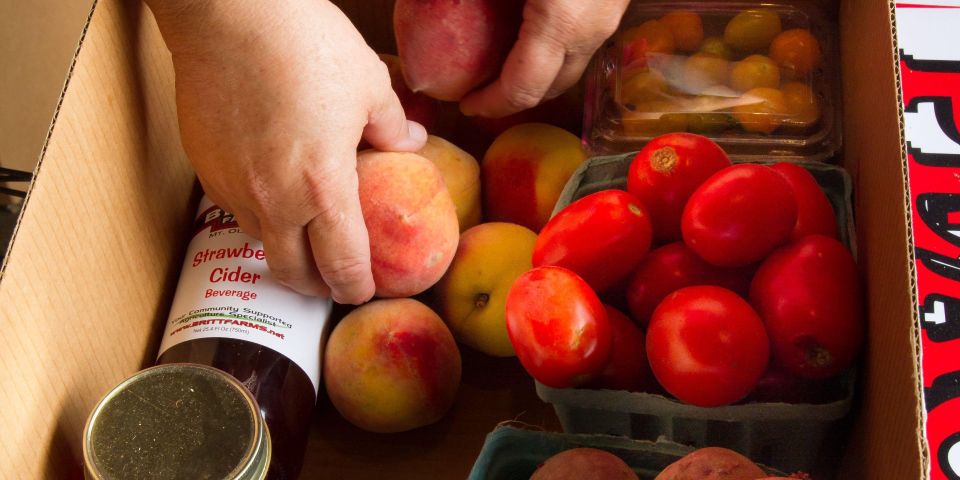
Fresh food from nearby farms can transform the health and economy of a community. Yet for many institutions, buying local remains frustratingly out of reach. This article covers why local food access is a community issue, how regional food hubs solve the logistics problem, and where The Common Market is growing next.
When we talk about local food access, the conversation usually starts with hunger and nutrition, but the impact runs a lot deeper than that.
Access to local produce shapes the health of entire communities. When people can reliably get fresh food close to home, chronic disease rates tend to fall, mental health outcomes improve, and health care costs decrease. These connections are part of what researchers call the social determinants of health, or the everyday conditions that shape how long and how well people live.
There's an economic dimension here, too. Local food systems keep dollars circulating within communities, support small farmers, and create jobs in distribution, retail, and food service. This helps spread economic opportunity more evenly across the community instead of concentrating it elsewhere.
And then there's the equity piece of the puzzle. Lasting food insecurity solutions have to account for the systemic barriers (income, transportation, geography, language) that make food access uneven in the first place. Local food access, done well, is one way to start closing those gaps.
Most small farms can't deliver directly to a hospital or school district. Most institutions can't manage relationships with dozens of individual producers. Regional food hubs solve that problem by aggregating products from multiple farms, verifying food safety, handling delivery, and providing transparent sourcing information on every invoice. They make farm-to-institution sourcing practical rather than aspirational.
The relationship works because both sides need what the other has. For farmers, institutional partnerships mean predictable revenue, the ability to plan growing seasons, and a path to scale. For institutions, it means fresher food, transparent sourcing, and procurement that reflects their values.
Forward purchasing commitments take this further. When institutions commit in advance to buying specific amounts from local farms, growers can plan, invest, and grow with confidence. That stability is what keeps small farms viable over the long term.
Dallas-Fort Worth: The Common Market expanded into North Texas in 2026, already delivering more than 30,000 pounds of Texas-grown products to schools, universities, and corporate cafeterias. Garland ISD, Southern Methodist University, and Bon Appétit's corporate dining in Dallas are among the early partners helping set a new standard for local food distribution in the area.
Westchester, NY: As the Mid-Atlantic hub continues to expand, its presence in Westchester stands out as a community where schools and healthcare institutions are increasingly aligned around values-based sourcing, and the supply chain is there to support them.
The Carolinas: The Southeast hub's expansion into the Carolinas addresses one of the most persistent food desert challenges in the region. Rural agricultural communities and urban institutions in the Carolinas have long needed a connector, and this expansion builds that bridge.
Michigan: The Great Lakes hub, based in Chicago, has been moving local food across the Midwest since 2023. Expanding further into Michigan means more farming institution partnerships, more family farms with reliable markets, and broader access to healthy food for communities across the Great Lakes region.
Local food access is built city by city, region by region, institution by institution. Each new partnership, each new delivery route, each school cafeteria or hospital that commits to sourcing locally adds another piece to a national food system that works for everyone. That's the vision The Common Market is working toward, and it's a vision these four new expansion areas are helping to make real.
Support the work that makes this possible today.
At The Common Market, our mission is to connect urban communities with fresh, healthy food from sustainable family farms. We're a nonprofit regional food distributor operating across the Mid-Atlantic, Southeast, Texas, and Great Lakes regions. We work alongside farmers, schools, healthcare institutions, and community organizations to build equitable, resilient regional food systems for everyone.
Since 2008, we've supported hundreds of family farms while delivering millions of healthy meal equivalents to the communities that need them most. If you're ready to bring locally sourced food to your school or institution, we'd love to partner with you.
Our friendly and educated team is here to partner with you every step of the way. Connect today to learn of all the ways to partner with The Common Market.
"The Common Market has a great selection of local and sustainable products that meet our school's needs and wonderful customer service as well. Quality of products is always high and getting orders delivered timely is consistent. We can feel good about our contribution to our local vendors as well."
— Germaine Appel, Executive chef and Nutritional Planner, Soulshine Preschool